
Passing time
in case you missed me

Hello again.
It has been three months since my last post. That was the first of an intended series dealing with the stations of the Moon. As you will have noticed by now if you have been reading this newsletter for more than a post or two, I am better at starting new series than following up on them. Indeed, I see this whole Substack experiment as a laboratory for working through ideas as they occur to me. The Prague astronomical clock continues to inspire some of those ideas, the stations of the Moon have inspired others. More will come, I’m sure.
There are three main reasons that I haven’t been writing. One was a planned surgery, which went fine and from which I am now recovered. The second has to do with my research position. As of 1 January, I have started a new project and the transition has me thinking differently about how this Substack fits into my ongoing work. It is now officially my job to study the history of astrology in the eastern Islamic world. Because of that, my ideas—and by extension, this newsletter—might get kind of wild in the coming years. I will keep the focus on topics related to astronomical timekeeping. However, all of astrology is premised on the astrologer’s ability to take a snapshot of the heavens at a particular moment and to project the movement of celestial bodies forward and backward through time. The boundaries between clock-making, horoscopes, and Moon phases will always be blurry, and the limits of this newsletter are bound to start blurring, as well. You have been warned. (Also, if you want something more on the starry side of things—less maths, more constellations—check out the Stelliferous newsletter by The Rebel Stargazer.)
A month after the Istanbul event that I wrote about last time, I attended a second conference dedicated to the topic of astrology. This was at the Max Planck Institute for the History of Science in Berlin and was dedicated to nativity charts produced in Persian sources from about the twelfth through the sixteenth century. The material I presented was from a largely unstudied text written (I think) around the year 1300, in which the author, a certain Iranshah Nishapuri, uses the horoscopes of Muhammad, Chinggis Khan, and a third unnamed figure to propose complex patterns for charting historical time.
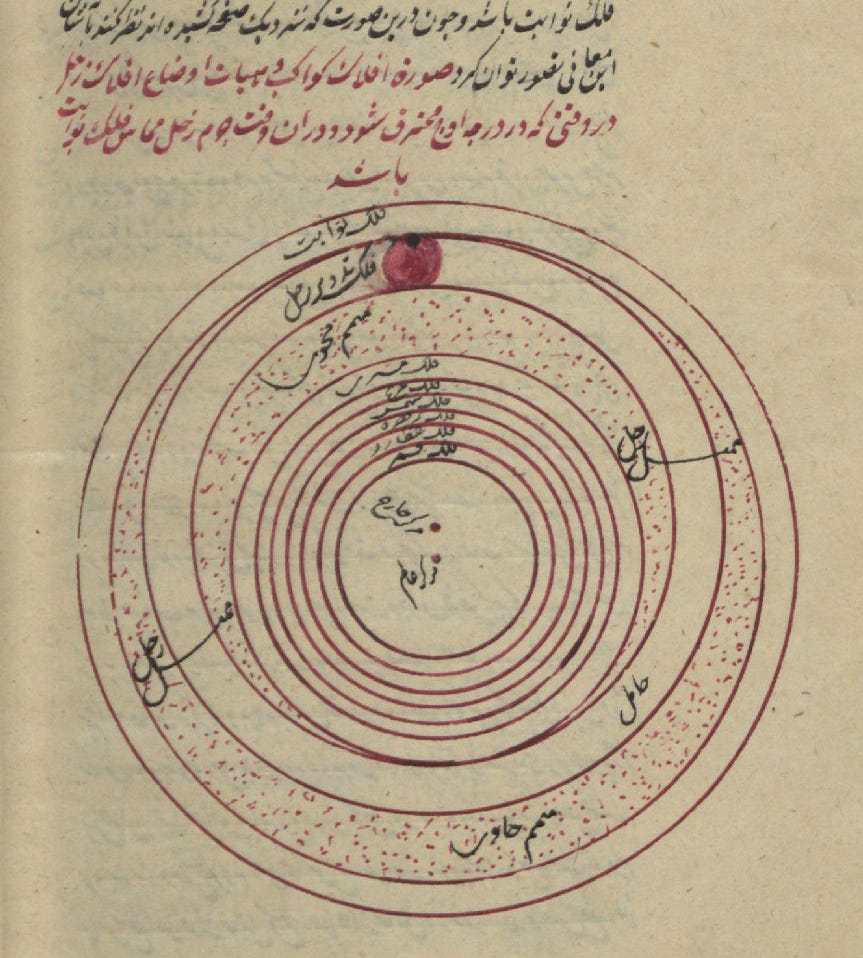
You and I are used to using years and months and days to mark time. All of these are based on observed celestial phenomena, namely the movement of the Sun through the sky and along the ecliptic and the phases of the Moon. For Iranshah, history could also be divided according to the periodic conjunctions of planets as they moved through the sky. Specifically, Iranshah argues the conjunction of Mars and Saturn in the sign of Cancer marked major moments of turmoil for the early Islamic community: the flight of the Prophet Muhammad to Medina, the assassination of the Caliph ʿUthman, the murder of Hussain, son of ʿAli, the murder of the Caliph al-Walid, and the beginning of the ʿAbbasid Revolution. After the rise of Chinggis Khan, which he dates to a moment when the Sun and Saturn were in conjunction in Sagittarius, Iranshah argues that the same conjunction became a marker for major moments in Mongol history: Chinggis Khan’s invasion of the Islamic world, his death, the death of his son Ögödei, the death of his grandson Möngke, the death of his great-grandson Abaqa, the death of Abaqa’s son Arghun, etc.
In finding patterns between celestial events and events on Earth, Iranshah was doing what we all do: assigning order to the passage of time. We talk about periods of time in terms of decades and centuries, as if ‘the Roaring Twenties’ or ‘the cinquecento’ were somehow internally coherent human experiences. We do this even though we know, scientifically, that nothing magical after each ten or 100 orbits of the Earth to set one period apart from another and even though the numbering of centuries is based entirely on the arbitrary determination by a group of medieval European monks about the year of Jesus’ birth (which they got wrong, anyway).
The difference between Iranshah’s method for dividing time and our own is that he had more options to work with. The effect of the Sun is obvious to anyone who can see light or feel warmth. The effect of the Moon is obvious to anyone who lives near the sea, and its phases are too compelling and regular to ignore as a timekeeping device. The idea that Saturn or Mars might be relevant to life on Earth gets us into the realm of astrology. In a world that believed strongly in the efficacy of astrology, it made perfect sense to use planets other than the Sun and Moon to tell time, since they influence on our lives just as the Sun and Moon do.
In particular, both of the sequences mentioned above involve Saturn: the Saturn-Mars conjunction in Cancer to mark important moments in Islamic history and the Saturn-Sun conjunction in the first degrees of Sagitarrius to mark important moments in Mongol history. Because Saturn takes thirty years to pass through the entire ecliptic (i.e., to orbit the Sun), each of these conjunctions happens on a roughly thirty-year schedule. Rather than thinking in terms of centuries, why not think in terms of ‘trigintaries,’ (which is a word I just made up, based on the Latin triginta, for ‘thirty’)?
The idea has its benefits. Few of us live to experience the scale of a century. But thirty years is just about a generation. How many of us get married at that age or have children, finish a degree or start a career? How many people around the age of sixty start to see grandchildren, or lose parents, or retire, or start over? All I’m trying to say is that Iranshah’s end result—a division of history into thirty-year increments—makes a lot of sense, regardless of where we stand on the question of celestial influence over mundane affairs. It makes as much sense, I would argue, as does a division of time into periods of a hundred years counted from the incorrect birthdate of a Palestinian Jewish scofflaw preacher.
Probably the most influential pattern that Iranshah uses, however, is in the chapter about his unnamed third protagonist. This is the individual he calls simply by the title Sāhib-i Qirān, and who was evidently born on 11 August 1265. Sāhib means ‘Lord’ and Qirān means ‘conjunction.’ (They are both Arabic words, borrowed into Persian.) The term Sāhib-i Qirān refers to the conjunctions of Jupiter and Saturn that happen just about every twenty years.
[Here’s the math: Saturn takes about 30 years to orbit the Sun, Jupiter takes 12 years. Therefore, if they start in the same observed place on the ecliptic, Saturn will make it through roughly 2/3 of an orbit in the time that Jupiter makes it through 1 and 2/3 of an orbit (30 x 2/3 = 12 x 5/3). The actual numbers aren’t quite so clean, which leads to really complex sequences of ‘lesser,’ ‘middle,’ and ‘great’ conjunctions, which I just don’t have time to get into right now.]
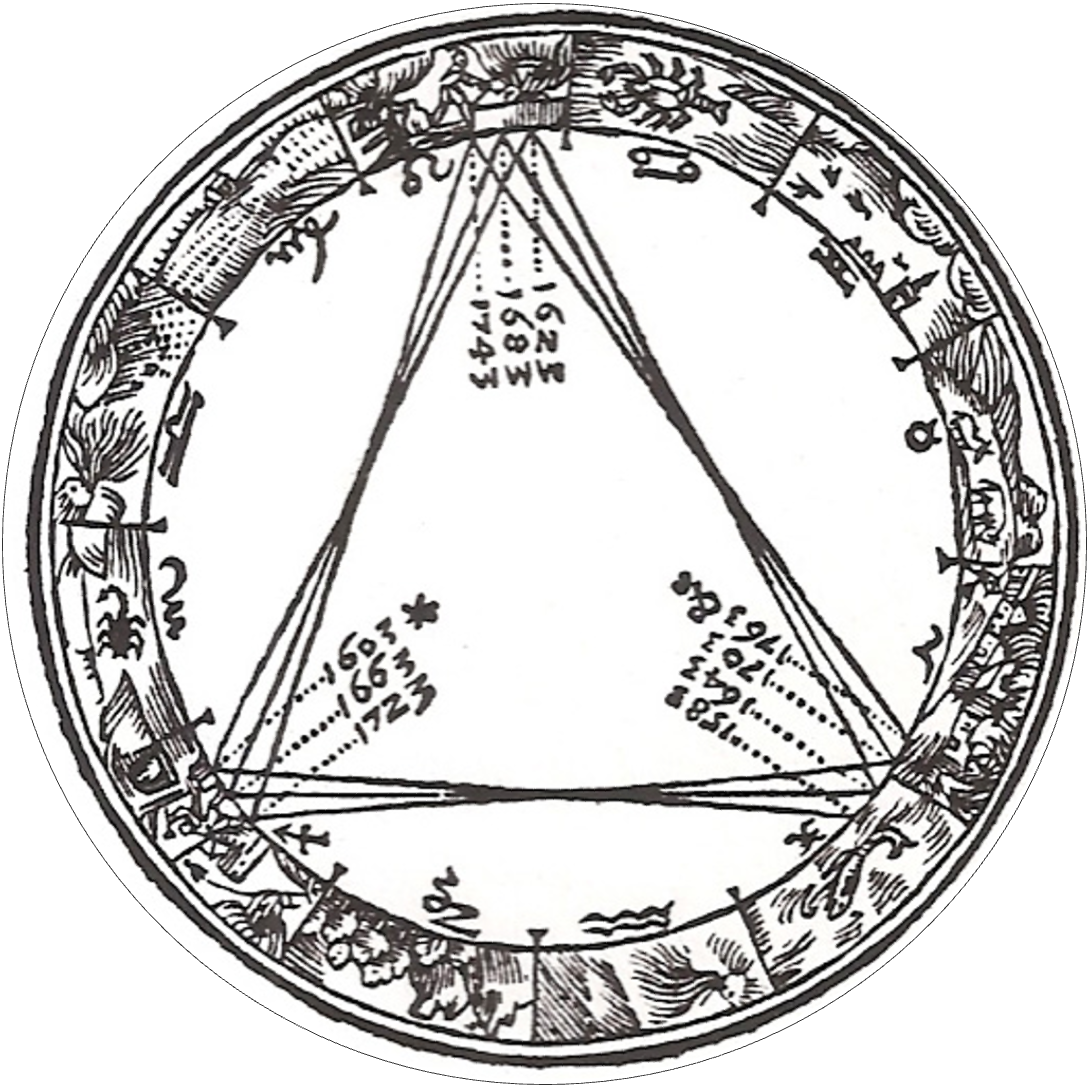
Many scholars translate Sāhib-i Qirān as ‘Lord of the [Auspicious] Conjunction’ because of the meaning of the individual words and the assumption that the Jupiter-Saturn conjunction is somehow auspicious. I believe that the title is better translated as ‘Lord of the Age,’ since it draws on the idea that the Saturn-Jupiter conjunction can be used to punctuate time. In its original astrological setting, Sāhib-i Qirān referred to whatever planet was believed to have the greatest influence in a horoscope cast for the moment of conjunction between Jupiter and Saturn. The astrological characteristics of that planet, then, were thought to predominate over the period up until the next conjunction, just about twenty years later. Think of how we talk about Baby Boomers, or Millennials, or Generation Alpha—people who are connected only by a particular period of time but who nevertheless are said to share some group ethos. Now imagine such groupings being characterised by the dominant planet of their age: the Saturnites, the Venusians, etc.
Over time, the title Sāhib-i Qirān was repurposed. From planets it began to be used for people. Tamerlane (d. 1405) is the most famous example. After him, various rulers of the eastern Islamic world claimed each to be the ‘Lord of the Age,’ the most influential figure over their own time.
For Iranshah, the Lord of the Age was born on 11 August 1265, but that’s basically all we know about him. Iranshah wrote a century before the time of Tamerlane, at a time when others were also playing around with the idea of the Sāhib-i Qirān as a title for a political figure. These included esoteric circles of Shi’ite occult scientists to Zoroastrian apocalyptic visionaries. All of them knew something major was going on (this was the age of the Mongol conquests, after all) and they looked to the stars both to explain what was happening in their world and to identify the figure that was going to get them through it.
This brings me, finally, to the third reason that I haven’t written in three months. Much of the last couple months has been spent writing a new biography of Chinggis Khan. I was asked to write it several years ago, and I initially tried not to, on the grounds that there are already enough biographies about Chinggis Khan and they all say pretty much the same thing. I’m glad my editor persisted, though, because it was a really interesting exercise, and I dare say I’ve written something a little different. I’ve tried to avoid getting bogged down in the big military campaigns that dominate most stories about the founding of the Mongol Empire. Instead, I take my time teasing apart the family relationships, social dynamics, and very personal decisions that informed Chinggis Khan’s early life. I’m sure I’ll have more to say about that project as it progresses through the editorial and publication process, so stay tuned. For now, here is an early draft of one of the maps I am working on for it:
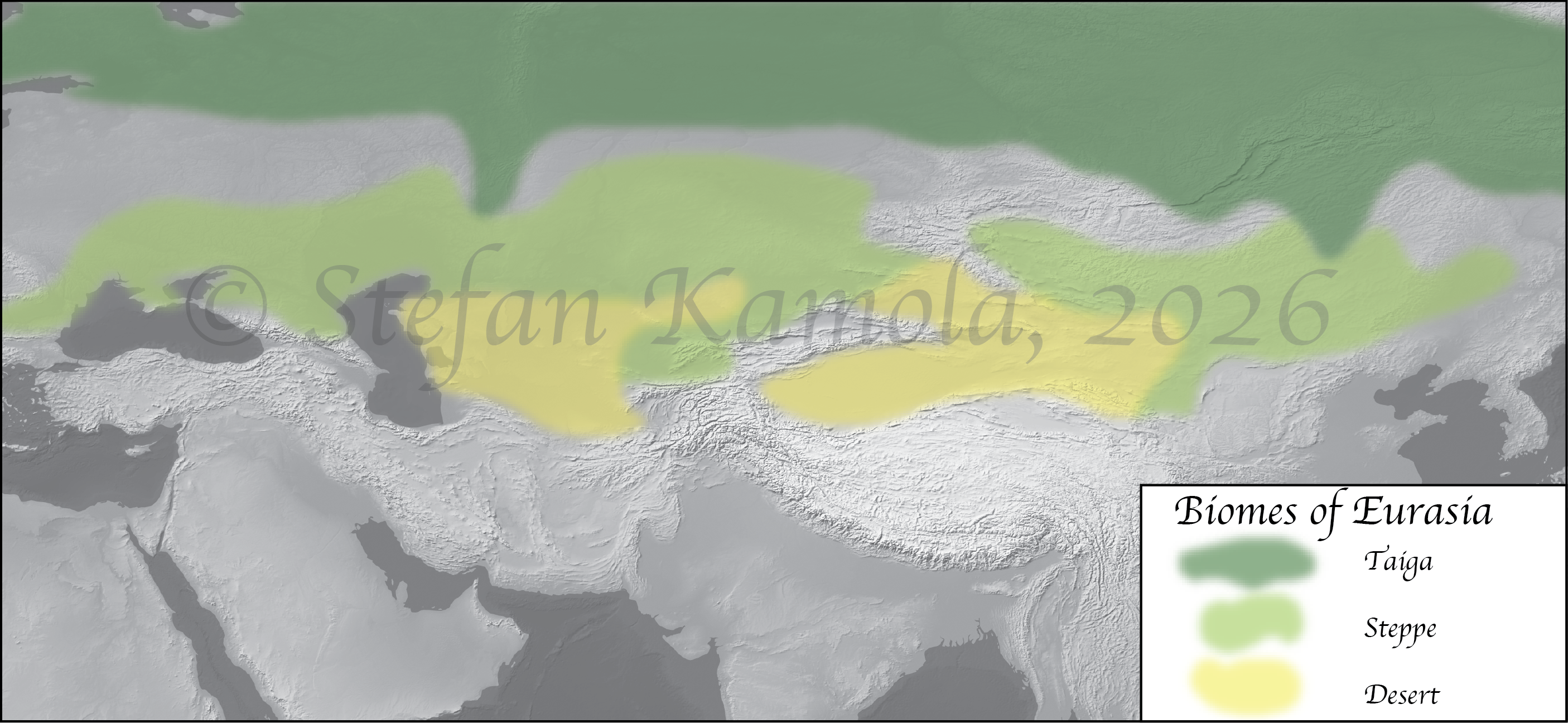
Twenty years ago, Joel Achenbach declared Chinggis Khan to be ‘Man of the Millennium’ in the ‘Style’ section of The Washington Post. If ever there was a modern equivalent to the title, Sāhib-i Qirān, this is it: the most influential figure to have lived during an arbitrarily defined period of 1000 years. One thing that intrigued me as I wrote about the stories of Chinggis Khan’s early life is how much timekeeping lies buried in the sources, accidentally preserved like insects in amber. In a nomadic society, the passage of seasons determines the rhythms of life even more than they do in a sedentary agricultural society. When we read undated accounts of a family ceremony or a childhood hunting trip, we can determine the season they occurred in based on the elevation of the nomadic camp, the migratory patterns of birds, or the temperature requirements for certain fermentation processes. We can thus arrange Chinggis Khan’s life into summer events and winter events, even if we cannot assign them to years.
All this just to say that there are many ways to mark the passage of time. I hope that you can forgive my three months of silence the way we might forgive a bear for taking a three-month nap. There are reasons for it, and the work continues.
Thnak you so much for the mention! Great to see you writing again. I think that with researching the history of astronomy or even understanding the nuances of timekeeping and celestial rhythms and mindful observation, many often overlook or dismiss the astrologers of the past because of their astrology, but of course the further back in time you go, the harder it is to untangle what we could call 'astronomy' and 'astrology'. Often one sees that the observers of old were very aware of the subtleties of the movements of heavenly bodies, and were very much into seeking patterns.